-
UnboxingBLR joins the record-breaking plantation drive on June 27th announced by the state government.
-
Spread across 8 kms and 6,000+ saplings, UBLR’s drive focuses on avenue roads, round-abouts in the new Kempegowda Layout
-
Thrust on native, colour-sequenced flowering species to ensure that some part of the corridor is always in bloom round the year
-
The plantation drive’s two-pronged approach keeps both aesthetics and environment in mind while boosting Bengaluru’s green heritage
UnboxingBLR joins forces with the Bangalore Development Authority’s (BDA) plantation drive with its uniquely designed Bloom Avenue project on the Major Arterial Road connecting Mysuru Road and Magadi Road.
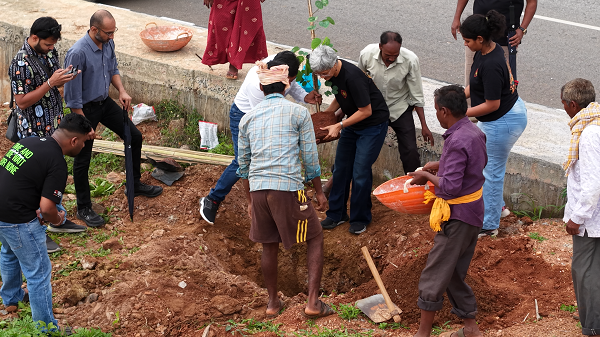 |
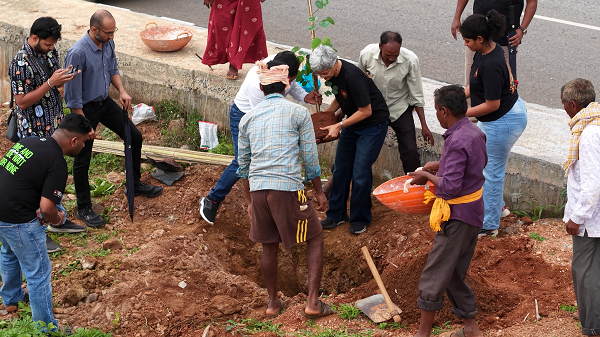
UBLR planting the first sapling for Bloom Avenue on Major Arterial Road
On June 27th, as part of Nadaprabhu Kempegowda Jayanthi celebration, the Karnataka government announced a single-day plantation drive with over 50,000 volunteers planting 1.5 million saplings in Bengaluru – targeting a spot in the Guinness World Record.
The city-focused not-for-profit UBLR participated in the initiative with its Bloom Avenue project. Along the major arterial Road in Kempegowda Layout and roundabouts, UBLR has begun planting 6000+ saplings across 8 kms.
UBLR’s plantation drive is at least partly inspired by the city’s green historical legacy. Bengaluru’s identity as India’s Garden City was never accidental, it was cultivated. The city’s most enduring botanical legacy traces to Gustav Hermann Krumbiegel, the landscape architect who shaped its parks and avenues in the early twentieth century. This received a major boost in the 1980s from the then Deputy Conservator of Forests (DCF) S. G. Neginhal who played a significant role in expanding Bengaluru’s urban tree cover and reinforcing its Garden City identity. Both Krumbiegel and Neginhal have given Bengaluru its defining character of tree-lined avenue roads and seasonal colour. That legacy has shaped how generations of residents relate to their city. Bloom Avenue is a conscious continuation of that tradition by restoring intentional, aesthetically considered greenery to a major urban corridor at a moment when the city’s green cover faces sustained pressure from rapid growth and densification.
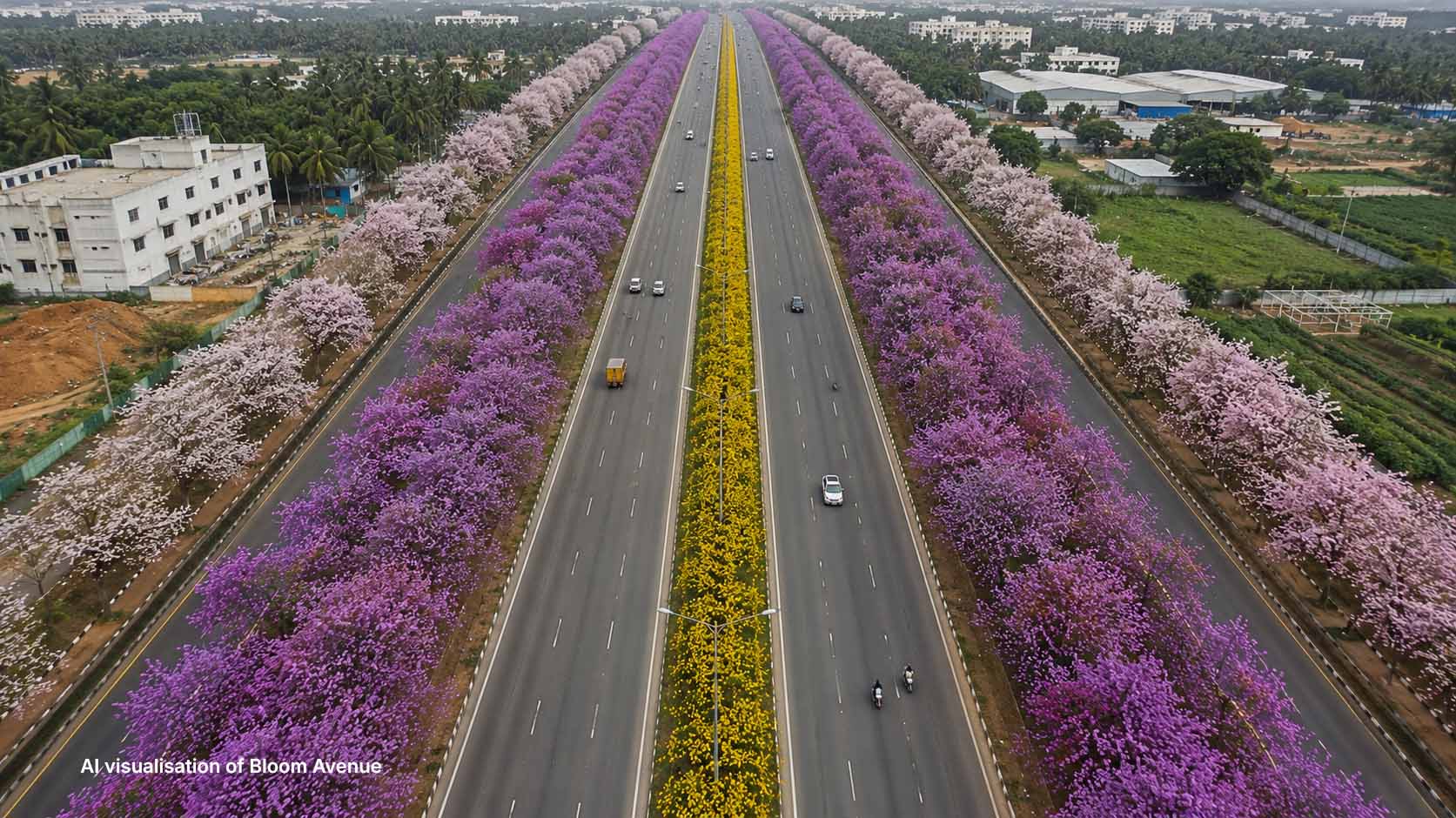 |
Bloom Avenue concept visualised using AI
UBLR’s Avenue Bloom focuses on flowering species that are colour-sequenced and coordinated so that some part of the corridor is in bloom every month of the year. The initiative strikes a delicate balance between aesthetics and native species in its plantation drive. Bloom Avenue is a deliberate greening intervention on a Bengaluru arterial road in recent memory. Further, the green initiative is designed to attract birds and butterflies to the layout when the saplings mature and grow into trees.
The Project Bloom is being executed in partnership with BDA, which also supplied the flowering saplings through its Forest Division. UBLR has funded and executed all ground-level operations, including pit digging and planting. UBLR will undertake all protective measures during the growth period and will be responsible for watering and maintenance of these plants for the first three years.
The corridor is divided into eight one-kilometre sub-zones, each planted with a distinct colour pairing drawn from complementary species ensuring that at least one sub-zone is in full bloom at any point in the year. Species selection prioritises indigenous varieties deeply adapted to Bengaluru’s climate; where naturalised non-native species are included, they carry strong cultural and botanical ties to the city’s history.
Phase 2 will extend planting to service roads alongside ongoing maintenance of Phase 1 saplings. The three-year maintenance commitment covers watering, monitoring, replacement of failed saplings, and upkeep to BDA standards.
“Long back, German botanist Krumbiegel made Bengaluru bloom all through the year. Decades later, the beauty of his work endures, enriching the city’s natural heritage and enhancing Bengaluru’s aesthetic appeal. Taking inspiration, Project Bloom focuses on both native species and flowering aesthetics to boost Bengaluru’s natural heritage for future generations. What makes this project special is the coming together of citizens, institutions, and government around a shared vision for the city,” Prashanth Prakash, Chairman, UnboxingBLR Foundation.
“We are very pleased to see Bloom Avenue move from concept to ground reality. The BDA has been glad to facilitate this, from providing the saplings and granting the necessary approvals, to supporting a model of civic collaboration that we hope will inspire many more such partnerships across the city. The Magadi Road–Mysuru Road corridor will be greener and more beautiful for it,” Major Manivannan P, Commissioner, Bangalore Development Authority.
“Bloom Avenue is exactly the kind of initiative Bengaluru needs by being citizen-led, rigorously planned, and built for the long term. A green, blooming corridor along Magadi Road and Mysuru Road will benefit the residents and communities and serve as a model for how our arterial roads can be transformed. We are happy to have it as part of the plantation drive for Kempegowda Jayanthi celebration on June 27th,” N. A. Haris, Chairman, Bangalore Development Authority.
About UnboxingBLR Foundation
UnboxingBLR (UBLR) is a Bengaluru-focused not-for-profit platform working with multiple stakeholders to envision and execute city-scale projects. UBLR operates at the intersection of content, culture, and city-building, documenting the city’s journey, shaping its civic agenda, and building programmes designed to last. Founded in 2023 by Prashanth Prakash and Malini Goyal, UBLR brings together people, communities, and institutions to co-create Bengaluru’s story, serving as a city champion, catalyst and an enabler for a range of initiatives.
UBLR drives initiatives such as BLR Hubba, a city-wide festival celebrating art and culture; Namma Bengaluru Challenge, a city-focused accelerator program that supports startups and changemakers tackling urban challenges; WeAreCity annual data report that offers multi-dimensional data-led insights on India’s top eight cities; Code to Culture, a podcast focused on voices and stories from the city. UBLR in partnership with the Department of IT/BT/DoE is also building India’s first Museum of Innovation, Startup and Technology in Bengaluru.