
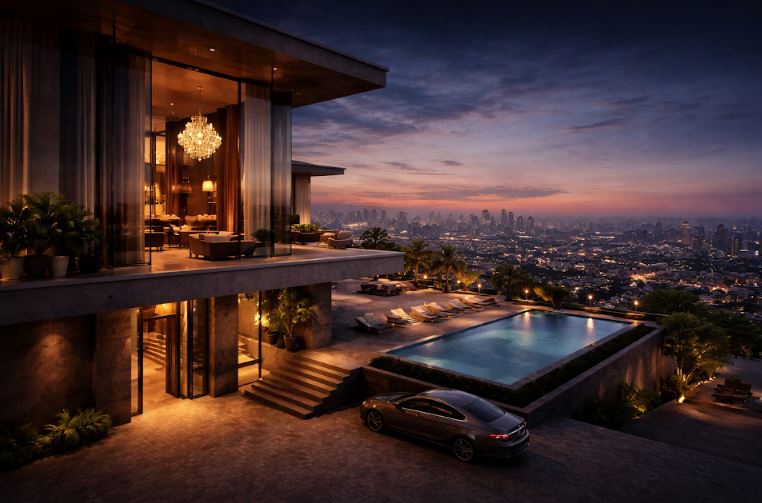
In the last few years, the word “quiet luxury” has increasingly entered the vocabulary of the discerning homebuyers. A 2026 global sentiment study by Sotheby’s International Realty notes that nearly 60% of its agents now see lifestyle-led decision-making overtaking investment logic in luxury transactions. That would have sounded impossible even three years ago, when yield and capital safety dominated buyers’ conversations.
 |
From subtle sophistication to curated expression – luxury homes in 2026 are designed not just to impress, but to reflect identity, elevate experience, and redefine everyday living
Earlier, luxury had an entirely different connotation, and the wealthy sought to showcase themselves. It was not minimalism in the classical sense; rather, it was a calibrated understatement, which has been labelled as “quiet luxury.”
Shyamrup Roy Choudhury, Founder and Managing Director, Aura World, said, “The luxury buyer we are engaging today is far more decisive and far less willing to dilute their vision. They are deeply involved in the decision-making process — from layout planning and material selection to design detailing — because they want their home to mirror their personality and aspirations. Earlier, there was a clear preference for homes that reflected discretion, understated design, neutral palettes, and an almost invisible expression of wealth. That has changed. Today, buyers are asking for curated interiors and amenities that align with their lifestyle — whether that means private wellness spaces, entertainment zones, or smart home integrations. They are not just evaluating aesthetics but also long-term comfort, functionality, and how the space enhances everyday living for their family.”
What is now emerging is not loudness in the conventional sense, but discernment. Private elevators opening into personal foyers are no longer indulgences; they are expectations in certain brackets. Double-height living areas are less about volume and more about stagecraft. Sky decks, once peripheral, are increasingly central to how projects are conceived, not appended later as an amenity.
Sehaj Chawla, Managing Director, TREVOC Group, said, “The change in buyer preference is also altering how projects are structured. We are seeing stronger demand for low-density complexes where privacy is preserved, but within that, the homes themselves are far more expressive. Today, buyers are also prioritising location above all, seeking well-connected and strategically placed developments that enhance convenience and long-term value. They are willing to invest in larger layouts, dedicated wellness infrastructure, and technology-enabled living. The emphasis is on control over space, services, and overall experience. In that sense, luxury is becoming less about scale alone and more about how intelligently that scale is used.“
Saurab Saharan, Group Managing Director, HCBS Developments, added, “In Gurugram, we are witnessing this transition play out very clearly. A couple of years ago, the conversation was still anchored around ticket size, connectivity, and future appreciation. Today, those factors are almost taken for granted. What buyers are really evaluating is how a home feels the moment they step into it, the arrival experience, the privacy gradient, the way natural light is handled, and even how seamlessly services are integrated.”
Kapil Chugh, VP, Sales at Rise Infraventures Limited, said, “The definition of luxury in 2026 has moved beyond both over display and quiet restraint to become far more intentional in how it is expressed. In our view, what stands out is the decisiveness of today’s buyer; they are globally aware, sharply discerning, and far less willing to compromise on how a space aligns with their lifestyle. This is, in turn, compelling developers to move past conventional residential formats and think in terms of integrated, experience-led environments. Homes are now being evaluated against hospitality-grade benchmarks, but with a deeper layer of personalisation.”
Branded residences are a natural outcome of this convergence. A collaboration with a known design house or a global brand does more than elevate positioning; it compresses the signalling process. One does not need to explain taste if it is already implied.
Ashwani Kumar, Pyramid Infratech, said, “There is definitely a stronger emotional component in purchase decisions today. Apart from evaluating location or return potential, buyers are evaluating how a home aligns with their identity and lifestyle. This naturally leads to more customised and expressive spaces. At the same time, we cannot ignore that these are still high-value assets. The challenge for developers is to balance individuality with a certain universality, so that while a home feels bespoke, it does not become too niche for the broader market.”
Sparsh Kaul, Vice President – Marketing, Orris Group, said, “Luxury is changing. It’s no longer just about sophistication; it’s about personal experiences and spaces that reflect who we are. People value beauty, wellness, and smart technology that makes life easier. They want homes that feel special today and remain timeless tomorrow. True luxury balances individuality with lasting elegance.”
Developers, for their part, are adjusting. Larger unit sizes are returning, but with more complex internal zoning. Clubhouses are evolving into experiential hubs rather than amenity clusters. Themed environments are being reinterpreted with more discipline. Perhaps the most telling shift is in how amenities are being discussed. The earlier vocabulary, gym, pool, and clubhouse, feels insufficient now. Conversations revolve around recovery zones, bio-hacking suites, private work lounges, and concierge layers that blur into hospitality.